As RWA tokenization expands from financial instruments into physical assets, digital infrastructure increasingly depends on information created outside the blockchain.
For physical assets, that information can take many forms.
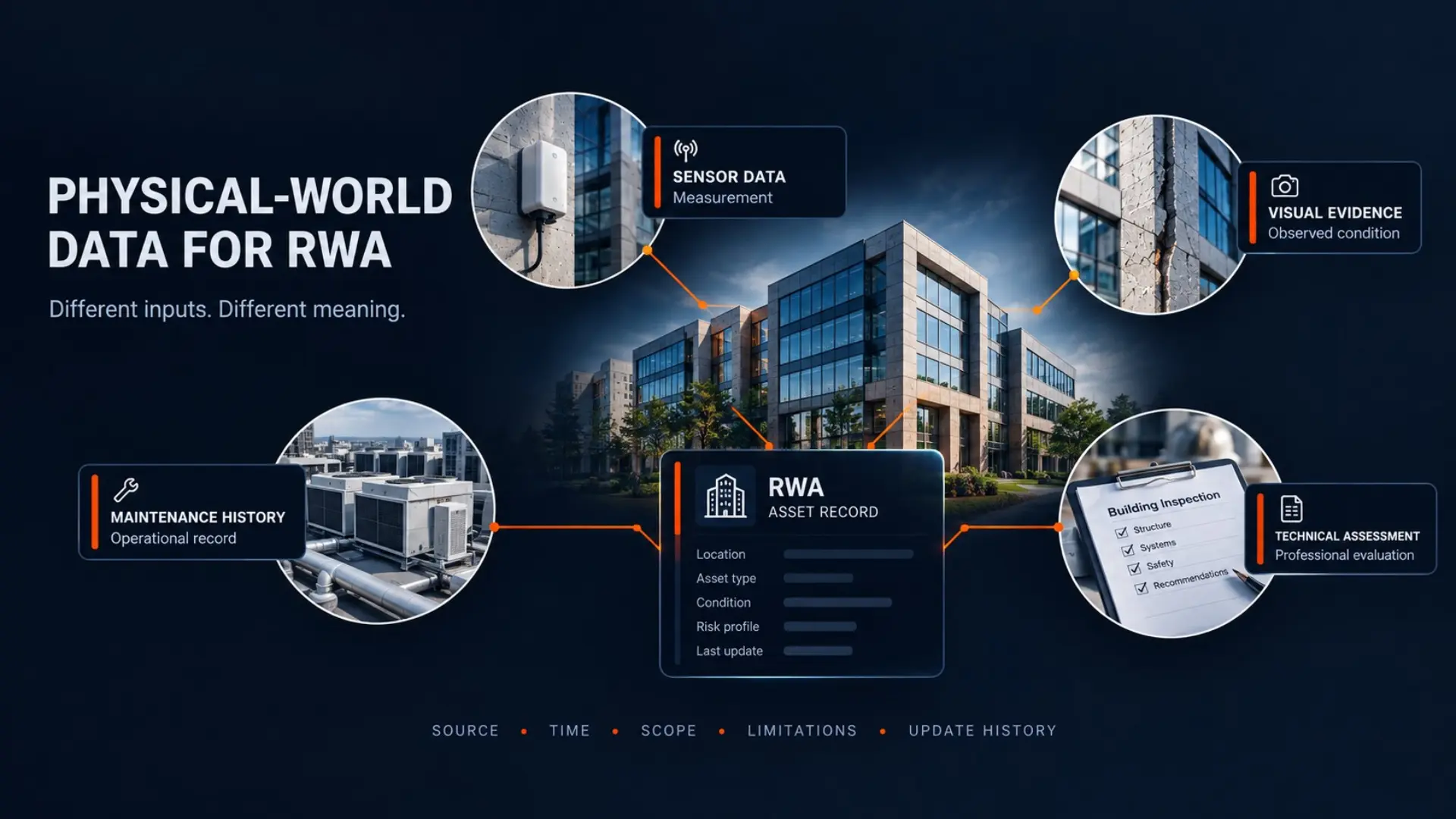
A building may generate sensor measurements, photographs, maintenance records, inspection findings, repair history and professional technical assessments. All of these may eventually become part of a digital asset record.
They are all real-world data.
But they do not mean the same thing.
Different sources describe different aspects of the asset, at different points in time, with different levels of interpretation and different limitations. Treating them as interchangeable can produce a digital record containing a large amount of information while still providing a poor picture of the physical asset itself.
For physical RWA, the challenge is therefore not simply getting more off-chain data into digital systems.
It is preserving what that information actually means.
One asset can produce very different kinds of information
Consider commercial real estate.
A moisture sensor can produce a measurement every few minutes. A site photograph may show visible cracking or water intrusion. A maintenance system may record servicing, inspections or repairs. A qualified professional may perform a Property Condition Assessment and evaluate the technical condition of the property.
All of these inputs relate to the same building.
But they answer different questions.
A sensor measurement describes a specific variable at a specific moment.
A photograph records an observable condition.
A maintenance record documents an activity or intervention.
A professional technical assessment combines observations, available evidence and professional judgment within a defined scope and at a defined point in time.
The problem begins when these fundamentally different inputs are flattened into a single category:
asset data.
Their digital format may be similar. Their meaning is not.
Newer data does not automatically replace broader evidence
Imagine that a building underwent a professional technical assessment six months ago.
Today, a moisture sensor reports a new reading.
The sensor reading is newer. But that does not make it a replacement for the assessment.
It may provide valuable information about moisture at one location. It does not automatically describe the condition of the façade, roof, structure, electrical systems or other parts of the building.
The reverse is also true.
The six-month-old assessment may describe the property much more broadly, but some of its conclusions may no longer reflect current conditions if deterioration, damage, repairs or another significant event occurred after the assessment.
This means that freshness and coverage are different dimensions of asset information.
A timestamp tells us when something was observed.
It does not tell us what the information is capable of establishing.
Evidence and interpretation should not be confused
A photograph of a crack can be useful evidence.
It may clearly establish that a visible condition existed at a particular place and time.
But the image alone may not establish why the crack appeared, whether it is cosmetic or structural, whether it is progressing, or what remediation is required.
Those conclusions may require additional inspection, measurements, historical evidence and professional judgment.
The same distinction applies to other information.
A sensor measurement is not automatically a diagnosis.
A maintenance entry is not automatically proof that the underlying defect has been resolved.
A record produced by an asset operator is not automatically equivalent to an independent technical assessment.
None of these sources is inherently useless.
They simply support different conclusions.
Physical RWA infrastructure needs to preserve those differences rather than remove them.
Physical-world data needs context
For physical assets, a useful digital record therefore needs more than the data itself.
It also needs the context that defines how the information should be interpreted.
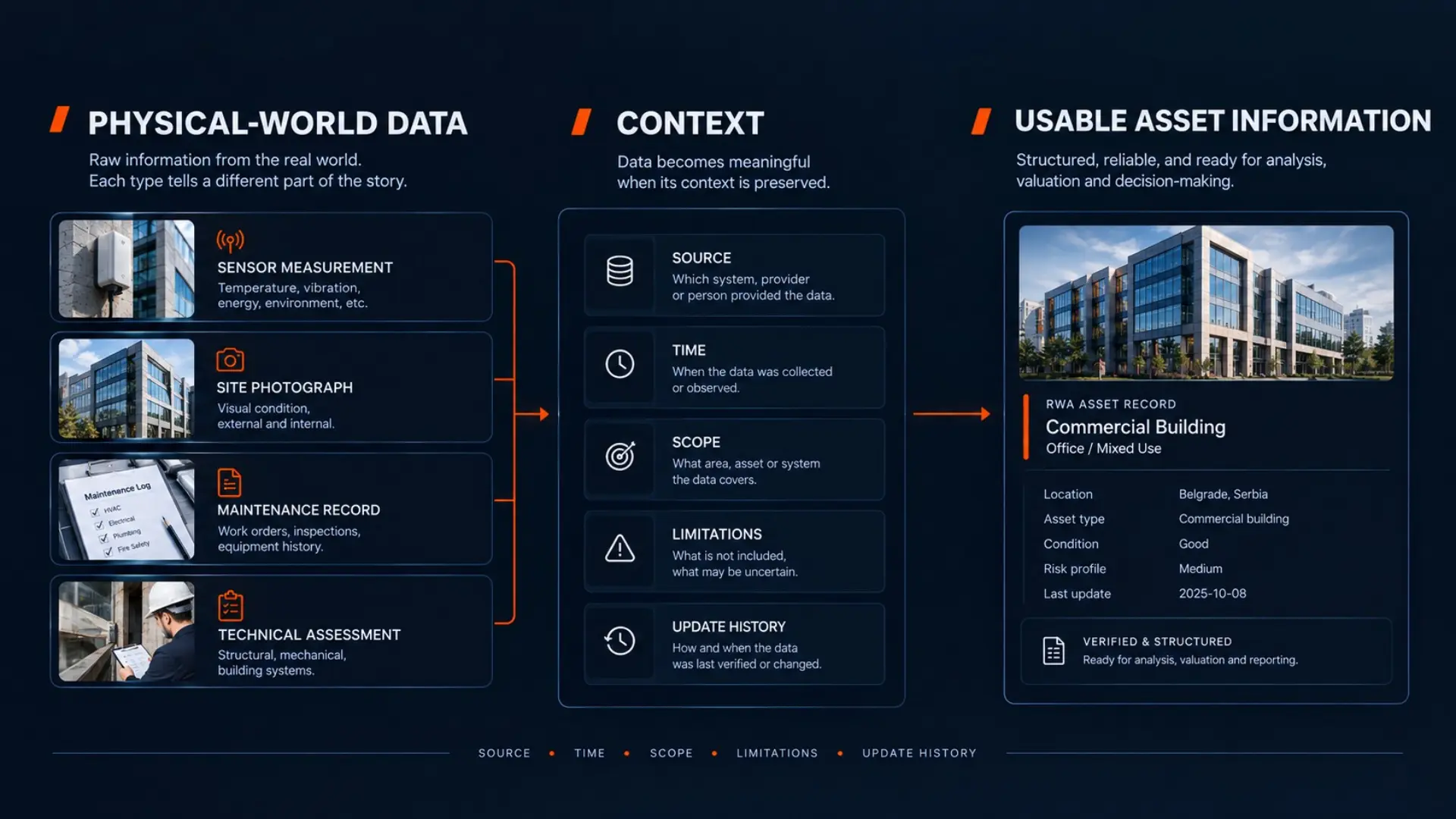
At minimum, important physical-world information should retain five attributes.
Source. Who or what produced the information?
Time. When was it observed, measured or assessed?
Scope. What part of the asset, system or property was actually covered?
Limitations. What was outside that scope, inaccessible or otherwise uncertain?
Update history. Has newer evidence changed what was previously known about the asset?
These attributes do not make bad information good.
They do something different: they make the information traceable and prevent it from being interpreted more broadly than the source supports.
An assessment without its date can appear current when it is not.
A photograph without its location and context may be difficult to interpret.
A measurement without information about its source may be misleading.
A professional conclusion without its scope may appear to cover an entire asset when only part of it was examined.
The infrastructure problem is therefore not simply transporting information from the physical world into a digital system.
It is preserving enough structure around that information for another party or system to understand how it can actually be used.
Blockchain can preserve a record. Preservation is not interpretation.
Blockchain can help establish that a digital record has not been altered after it was issued.
That is useful.
But integrity of a digital record and meaning of the physical information behind it are separate problems.
An immutable six-month-old assessment is still six months old.
A securely stored photograph remains visual evidence, not an engineering diagnosis.
A cryptographically protected maintenance record still does not establish that a repaired component is currently performing as expected.
Digital integrity matters.
But it does not eliminate the need to understand what the original physical-world input actually established.
For physical assets, this creates an information layer between the real object and its digital representation.
That layer has to preserve not only records, but their meaning and boundaries.
Physical assets create a lifecycle problem
There is another complication.
The underlying physical asset continues to change after its first digital record is created.
A building may undergo a technical assessment in January.
A material event may damage part of the property in March.
A reassessment in April may identify changes in condition.
Repairs may be completed in July.
A later assessment may then establish a new current state.
The previous assessment was not necessarily wrong.
It described the building at an earlier point in time.
The mistake would be to silently overwrite that state and retain only the latest conclusion.
Each stage contributes to the history of the asset.
The original assessment matters.
The event matters.
The new evidence matters.
The repair matters.
The updated condition matters.
For physical RWA, a useful digital record therefore needs to represent both current condition and condition history.
This is especially important when the financial representation of an asset can remain active while the underlying physical property changes.
The digital instrument may be unchanged.
The building may not be.
What the infrastructure layer actually needs to do
None of this means that every photograph, sensor reading or technical document should be stored onchain.
That would confuse data storage with useful infrastructure.
The more important task is preserving the relationships between different types of physical information.
The system should be able to distinguish a raw measurement from visual evidence, operational history from professional assessment.
It should preserve the source, date, scope and limitations attached to important information.
It should retain previous states rather than silently replacing them.
And when new evidence appears, it should show how that evidence changes what is currently known about the physical asset.
In other words, physical-world information needs to remain structured, traceable and time-aware as it moves into digital asset infrastructure.
That is what turns a collection of records into usable asset information.
Where SPEC fits
This is the part of the problem we are working on at SPEC INTELLIGENCE for real estate.
SPEC is not designed to move every photograph or engineering document onto a blockchain.
The objective is to translate professional physical inspection data into a standardized technical record that digital systems can use.
The current SPEC Protocol combines structured data capture, professional engineering assessment, evidence checks, a Technical Condition Grade, an Indicative CapEx Range, a defined validity window, versioning and machine-readable output.
The important principle is not simply that the output is digital.
It is that the output retains enough structure to understand what was assessed, on what evidence, within what boundaries and at what point in time.
That matters for tokenized real estate, but it is not limited to tokenization.
The same problem exists for lenders, asset managers, owners and other institutions that depend on physical property information.
Tokenization simply makes the gap between the digital record and the changing physical asset harder to ignore.
SPEC Protocol v1.1 explicitly frames the output around structured engineering data, evidence dependencies, a validity window, versioned logic and API-ready machine-readable records.
From real-world data to usable asset information
RWA infrastructure will continue connecting more external sources to digital assets.
Sensors will become more common.
Inspection workflows will become more digital.
Property and operational systems will expose more information.
AI will make it easier to process photographs, reports and measurements.
But more inputs do not automatically create a better representation of a physical asset.
A million sensor readings do not equal a Property Condition Assessment.
A folder of photographs does not establish a verified technical condition.
A maintenance database does not automatically tell an investor or lender what condition the building is in today.
The infrastructure has to preserve the distinctions between those sources.
For physical RWA, useful asset information must retain what was observed, who produced the information, when it was produced, what it covered, what it could not establish, and how newer evidence changed the previous picture.
That is the difference between merely collecting real-world data and building a digital record that can meaningfully represent a changing physical asset.